The Italian Institute for the Future (IIF) and the Institute for Economics and Forecasting (IEP) of the National Academy of Sciences of Ukraine signed a memorandum of understanding during a ceremony in Naples on Wednesday 11 May 2022. The document, agreed between the parties, provides for the launch of a series of joint activities between the two research institutes, starting with the analysis of the political and economic consequences of the war against Ukraine at European and world level; this study is part of a broader project of social and economic recovery of Ukraine.

“Futures Studies, which our institute promotes in Italy, was born as an offshoot of Peace Studies in the 1960s: at the time the goal was to avoid a new world war and guarantee a peaceful future through collaboration between the East and West. Today we have a similar task “, underlined Roberto Paura, president of the Italian Institute for the Future, in his speech.

“As academic institutions specializing in the study and solution of long-term problems, we have faith in the future,” said the director of the Institute for Economics and Forecasting, prof. Valeriy Heyets, in direct connection from Kyiv with several other academics, pointing out that the challenges that the two institutes are called to solve are on three levels: recovery of Ukraine and its participation in the European integration process; the search for solutions to ensure a low-carbon future for climate sustainability; the mitigation of future potential health crises after the Covid pandemic and the long-term effects of pandemic stress.

The Consul General of Ukraine in Naples, Maksym Kovalenko, who attended the ceremony together with Consul Vassyl Shvets, emphasized that the greatest heritage of Ukraine is represented by the Ukrainian people, who have in Campania one of the largest communities in Europe, to which about twenty thousand refugees have been added since the start of the war. The Consul pointed out the agreements signed in recent weeks with universities, research centers and industrial groups in Southern Italy to strengthen Ukraine and its future.

Among the first tangible results of the collaboration, the appointment of Adriano Cozzolino, director of the Center for European Futures of IIF, as a member of the editorial board of the Journal of European Economy, and of Alex Sharov of IEP in the scientific committee of Futuri, the magazine of the Italian Institute for the Future, as well as a series of joint publications between the two institutes. IIF will also make available some scholarships for Ukrainian refugee students in Italy to participate in the training activities scheduled in the coming months. The coordinators of the agreement will be Sergiy Koroblin for IEP and Vincenzo Torre for IIF.

The ceremony was attended in presence by the Ukrainian delegation: Oleksandr Sharov (Chief Researcher at IEP), Tetiana Sharova (Professor Emeritus of the Ternopil Institute for National Economy and former director of the TACIS program in Ukraine), Inna Sheshnova (cultural mediator for Ukrainian refugees in Campania). In connection from Ukraine participated: Valeriy Heyets (Director IEP), Sergiy Korablin (Deputy Director IEP), Olena Borzenko (Head of IEP international finance department), Yevhen Savelyev (Director of the Journal fo European Economy, lecturer at West Ukrainian National University ). For IIF the ceremony was attended by Roberto Paura (President), Daniela Porpiglia (Vice President), Vincenzo Torre (Head of international relations), Adriano Cozzolino (Director of the Center for European Futures).

MOU ENGLISH TEXT

MOU UKRAINIAN TEXT 

At the end of the European project “Youth Voices Matter – YMOVE”, are now available the analyses and recommendations carried out by the participants in the project on the topics of youth unemployment, education and training, climate change.

The project Youth Voices Matter – “Y-MOVE” is a transnational initiative for young people from three different countries: Greece, Italy, and Spain. The main aim of the project is to empower youth’s active participationin the policy-making process. The main objectives of the project are:
– to raise awareness and to strengthen activecitizenship attitudes;
– to reinforce youth participation and engagement insocial, civic, and political life;
– to increase active and informed participation in thedemocratic decision-making process;
– and to improve the interpersonal competencies ofyoung people.

The method followed in this project is the structured dialogue and a participatory approach, to develop a connection and a dialogue between youth and policymakers. This booklet is the result of the simulation of the policy creation process in the format of round-table discussions. Inputs were previously given to the participants through the presentations of relevant topics by experts and through non-formal education learninga ctivities.

The project was a joint effort of EKO Greece – Entrepreneurship and Social Economy Group (Greece), the Italian Institute for the Future (Italy), and LAS NIÑAS DEL TUL (Spain). Each of the three countries was represented by a team of 13 young participants (18-30 years old) and two decision-makers/experts in the field of main project topics. The two decision-makers/experts were the facilitators during the round-tables session.

The final document presents a summary of the analysis conducted by the participants and the recommendations proposed, including:

For the issue of youth unemployement:
– Stricter & more regular public inspections
– New legal figure of Advisor/Tutor foryoung employees
– Resize classrooms
– Dual examination
– Longer high quality paid internshipsfor all

For the issues of education and training:
– Taking the model of dual education
– Creation of education curricula in cooperation with the private sector
– Soft Skills in Academic Curricula
– Facilitate the connection between what teachings and labor market
– Mandatory pedagogical training
– European Teaching Evaluation System
– Teacher Training Bonus

For the issues of climate changes:
– Increase accessibility to smart multimodal mobility
– Encourage individual virtuous choices in urban and extra-urban mobility
– Invest in educational programs about smart mobility

DOWNLOAD THE FINAL DOCUMENT

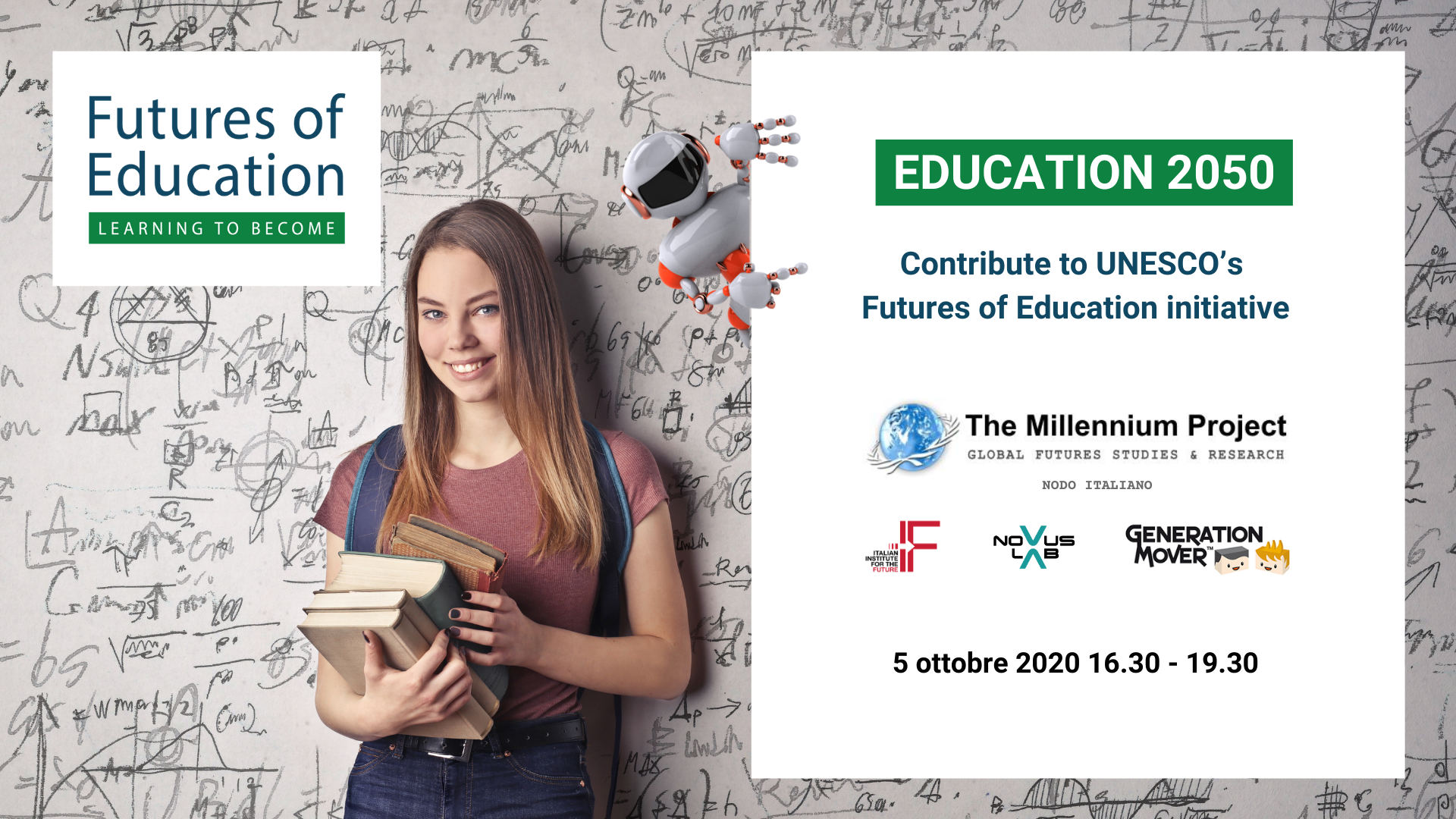
UNESCO has launched the initiative “Futures of Education: Learning to Become” with the aim of rethinking education models for the future: a global debate on how knowledge, education and learning should be re-imagined in a world of increasing complexity, uncertainty and precariousness, to shape the future of humanity and the planet.

UNESCO’s Director General has established an independent International Commission for this purpose under the direction of the President of Ethiopia, Mrs. Sahle-Work Zewde, to develop a global relationship on the future of education. The members of the Commission include leading figures from the worlds of politics, academia, arts, science, business and education. The Commission will carefully evaluate all inputs from the global consultation process launched with the Futures of Education initiative, in a collective intelligence effort that will feed into a final report and other in-depth papers.

The goal is to rethink the role of education, learning and knowledge in light of the great challenges we are facing and the opportunities offered by the consideration of possible and preferable futures, following the approach of the so-called futures literacy.

The initiative “Futures of Education: Learning to Become” is involving citizens, organizations, institutions and networks around the world to spread the debate on how knowledge and learning can change the future of humanity and the planet.

For this reason, we have decided to provide a contribution on such an important topic, starting a deepening work that includes several works.

The Italian node of the Millennium Project, the Italian Institute for the Future, Novus Lab and Generation Mover will coordinate a first structured national participatory debate workshop entitled “Education 2050” to be held online on Monday, October 5, 2020, from 4.30 to 7.30 PM (GMT+2).

The event is open to interested people of all ages and backgrounds. The number of participants is limited and the selection criteria will favour the construction of a multigenerational, multidisciplinary and gender-balanced panel. To apply to participate in the workshop, you must complete the application form by September 26, 2020. Candidates will be notified about the selection by September 27th.

Participation is free of charge. The contributions offered during the debate will be included in a report sent to the UNESCO Commission and published in Italian and English by the organizers.

Let’s build our future together!

Fill in the participation form

For any information, you can write to mdiberardo@gmail.com.

More information about the initiative, are available at https://en.unesco.org/futuresofeducation/.